Friday, February 29, 2008

Bye Bye WaWa

My roommate received a call at 11 last night that there was a crowd gathering outside our local WaWa to protest its closing. Curious, we walked over and found people holding signs and roaming the empty aisles of the store. As employees were taking down signs, people were excitedly grabbing them as souvenirs. It was not really, then, an angry protest--it was more like a going away party for an old friend who was leaving too soon.


Friday, February 22, 2008

Snow day


We've finally had our first snow day in Philadelphia...this little guy seems to have a snowball stuck to his tail!

Wednesday, February 20, 2008

Happy birthday, George Washington!

Coincidentally, George Washington's birthday is falling only about a week after I've been reading through some of his papers for my own research. The picture I'm forming of him, from the bits I've read, is of a very formal, reserved person who seems to have spent a large chunk of his time in Philadelphia drinking tea.

But Wonkette, in its usual snarky way, has put together a funny bio post on Washington. The post summarizes what we know of Washington, identifying him as the guy "who led the terrorist insurrection against the Tory Empire and eventually seized control of the United States just as modern-day terrorists hope to win the presidency in November." It goes on to list a number of random facts, most interestingly that he didn't free his slaves upon his death--they would only be free when Martha died. Apparently she ended up living in fear of being killed by them.

I felt a bit embarrassed that I had no idea that this was the case, whereas somebody at Wonkette did, so I did a bit of digging. It turns out that there is a lengthy passage in Washington's will that explains his reasoning and leaves detailed instructions on the treatment of his slaves. It seems that he didn't want to free his slaves until Martha's death because his slaves were intermarried with hers, and freeing only his would "excite the most painful sensations."

Thursday, February 14, 2008

A visit to the opera

Last night I went to see my first opera, Cyrano. The Philadelphia Opera Company is putting on an original adaptation of the famous French play, based on the life of a Frenchman named Cyrano de Bergerac. I apparently can't escape my historical work, because as it turned out, the program had an entire section on a topic I've read a bit about recently--French salon culture. The heroine, Roxane, represents the literate and intellectual women of the salons who expected men to woo them with eloquent writing and wit. My favorite scene was when her lover is trying to win her over and declares several times, "I love you!" to which she responds "Oh! without a doubt!--and then?..."

These lines, of course, were all sung in French and in the curious trilling of opera. I must admit, I've avoided opera in the past because I'm not a fan of the singing style, and I haven't been won over yet. But there is something amusing about seeing mundane conversation sung melodramatically by people in fantastic costumes. And the price couldn't be beat--$5 for ampitheatre seats, from which I could almost touch the beautiful ceiling of the oldest grand opera building in the country.

Tuesday, February 12, 2008

A Rhetorical Question

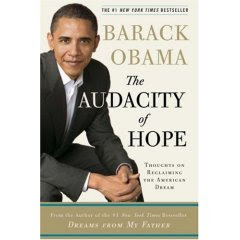
Audacity: n., boldness; fearless daring. This is what Barack Obama invoked in the title of his most recent book, The Audacity of Hope. He acknowledges here that his message of hope is not one that people will accept readily; it takes a sort of determination to go against the tedium of politics to accept his rhetoric, the title suggests. Some people I've talked to would agree--and they just don't feel quite daring enough.

The question to me is not just why they can't summon the audacity, but why we should need it in the first place. I'm not by any means a naive idealist; I'm probably more cynical than most people about politics and the failures of our government. But when a leader takes hold of the zeitgeist of the time and speaks in a way that is compelling, intelligent, even emotionally stirring, this seems to me to be exactly what we ought to embrace.

This, in great part, is what we admire about our greatest leaders, from George Washington to Martin Luther King, Jr. Let me be clear: I am not comparing his leadership abilities (as yet untested) with these leaders', but his rhetoric resonates with the sounds of his predecessors. He has harnessed MLK's intonation, and he speaks of unity, the urgency of action, and the future in ways that great leaders have in the past. Here, for instance, is a bit of Jefferson's first inaugural address:

"Let us, then, fellow-citizens, unite with one heart and one mind. Let us restore to social intercourse that harmony and affection without which liberty and even life itself are but dreary things."

and FDR's third inaugural in 1941:
"In the face of great perils never before encountered, our strong purpose is to protect and to perpetuate the integrity of democracy. For this we muster the spirit of America, and the faith of America. We do not retreat. We are not content to stand still. As Americans, we go forward, in the service of our country, by the will of God."

and MLK's I Have a Dream speech:
"We have also come to this hallowed spot to remind America of the fierce urgency of Now. This is no time to engage in the luxury of cooling off or to take the tranquilizing drug of gradualism. Now is the time to make real the promises of democracy...

We cannot walk alone. And as we walk, we must make the pledge that we shall always march ahead. We cannot turn back."

How, then, are these words of Obama's so very different?
"We are the hope of the future; the answer to the cynics who tell us our house must stand divided; that we cannot come together; that we cannot remake this world as it should be.

Because we know what we have seen and what we believe - that what began as a whisper has now swelled to a chorus that cannot be ignored; that will not be deterred; that will ring out across this land as a hymn that will heal this nation, repair this world, and make this time different than all the rest - Yes. We. Can."

If we know these men made great leaders, that they acted according to the boldness of their words, than why do we assume Obama is all rhetoric? It's a rhetorical question--but one very much on my mind this election.

Wednesday, February 6, 2008

Age through the ages

Jane Austen's Bennet girls go husband-hunting to avoid becoming old maids

On the eve of my 25th birthday, I was thinking about what a woman my age would have been doing in the past--because she certainly wouldn't have been single and working on her PhD even 50 years ago. So, to put it in perspective:

Ancient Greece: Girls were married between 12 and 14. Under that plan, I'd probably have an 11-year-old child by now and I wouldn't be able to leave the house much--women were confined to the house.
Medieval Europe: By age 25, a girl could have been married for anywhere from 7 to 15 years already. If she could even read, it was unusual, and she probably signed her name with an X.
Jane Austen's England: By now, at least being educated is seen as a good thing for a woman, although your education was long over by 25. Given that Jane Bennett in Pride and Prejudice was 22 and considered at the edge of being an old maid, it didn't look good for a single 25-year-old--she'd be a financial burden on her parents and seen as a spinster.
My grandmother's time: By 25, my grandmother was married and had given birth to my aunt and my dad. She didn't get to go to college, and she kept busy taking care of the kids while my grandfather went to work and college on the GI bill.

So, where does that leave me? Clearly, with a very different life at 25 than women who came before me, but what I really can't fathom is having children already. Most 25-year-olds I know--male or female--are more interested in making a life for themselves and finding their passions than in starting a family. Does having time to find our passions make us happier? Or would we be happier married and settled, expectations laid out for us? Let's just say I think I make a better student than a housewife or mother at this stage.

Sunday, January 20, 2008

Election time means history is up for grabs

That, at least, seems to be particularly true this year. From the comparisons between Romney's religion speech and JFK's, the controversy over MLK, Jr., brewing between Clinton and Obama, and Obama's Reagan reference, (ill-conceived) history as been at the center of some contentious debates. As historian Sean Wilentz wrote in a recent column, "In war, truth is the first casualty--but in politics, it appears that the first victim is history."

Can we really judge candidates by their invocations of the past? A group of NH newspapers which endorsed Hillary Clinton noted that her list of favorite presidents (later corrected to note that it was a list of presidential portraits she'd hand in the White House) "demonstrates how she thinks." Even worse is when historical references are deceptive or just plain wrong. Republican posturing with evangelicals often means invoking the religious faith of the founding fathers, ignoring the obvious deism and desire for separation of church and state among the founders. As one columnist notes in comparing how Romney and JFK used religious history, "Jack Kennedy had an eye for history; Romney has only a tin ear."

So what are historians looking for in a candidate this primary season? If the online endorsement of Obama by a lengthy list of history professors is any indication, they're looking for the attributes of greatness they've seen in presidents in our history who have changed "the mood of the nation." They cite Lincoln, FDR, and JFK. No founders there, but then their hopes that Obama will improve our role in the world and expand government programs wouldn't really have been on the early presidents' agendas.

Circumstances change, times change, and sometimes the examples of the past are more or less productive than others. We can't expect politicians to use history selflessly, but let's hope they can learn to use it wisely.