 Playing on the historical story of Paul Revere and, perhaps more subtly, the fact that we may have more to fear from large corporations than from countries.
Monday, May 31, 2010
The British are coming!
Playing on the historical story of Paul Revere and, perhaps more subtly, the fact that we may have more to fear from large corporations than from countries.


Wednesday, May 19, 2010
Market St, Past and Present
Despite the sunny spring weather, I found the below sight on Market St in Old City this weekend rather depressing:
 Images like this of urban decay alternate with hip boutiques and historic buildings in Old City and other parts of Philly. What did this same spot look like just over 100 years ago?
 Photo of 306 Market St by Frank Taylor, undated, Free Library of Philadelphia
 Images like this of urban decay alternate with hip boutiques and historic buildings in Old City and other parts of Philly. What did this same spot look like just over 100 years ago?
 Photo of 306 Market St by Frank Taylor, undated, Free Library of Philadelphia
It was certainly a lot more quaint in the past, but look closely: the sidewalks were filthy (just like now!) and while the horses in the picture might look cute, they didn't smell cute.
Here's another view of that same area in an undated postcard, all spiffied up with added coloring and the ultra-modern trolley system.
 Free Library of Philadelphia
And finally, William Birch's 1800 rendering of the Southeast Corner of Market and 3rd
 New York Public Library
Some further historical digging shows that this part historic/part gentrified/part decayed block was home to a drug store owned by the son of famed botanist William Bartram in 1785, several homes of the prominent Wistar family, a dry goods store, and the terminus of a railroad.
To check out more (and hopefully more encouraging) historical image comparisons, check out the Free Library's photo map.
Here's another view of that same area in an undated postcard, all spiffied up with added coloring and the ultra-modern trolley system.
 Free Library of Philadelphia
 New York Public Library
To check out more (and hopefully more encouraging) historical image comparisons, check out the Free Library's photo map.
Tuesday, April 6, 2010
Virginia is for lovers...of confederate history!
It seems logical enough that the state of Virginia, home of numerous Civil War battlefields and historic sites, would want its residents to know about the state's wartime past. It's good for general knowledge and for tourism. Perhaps, then, the state would even have a month devoted to the history of the war--Civil War History Month, perhaps, just like Women's History or African American History Months.
But this is the state where in recent months state universities were told to end their anti-discrimination policies towards gays and the state legislature passed a bill to allow residents to carry guns into restaurants. So, in true Virginian style, the governor signed a proclamation today making April "Confederate History Month."
You could argue that since Virginia was the seat of the Confederacy, this makes some sense. But beyond the far-from-PC name choice, there is the proclamation itself. While the last governor to make the proclamation in 2002, Jim Gilmore, had added language condemning slavery to George Allen*'s original 1997 declaration, the current governor Bob McDonnell's proclamation never mentions slavery. The proclamation also describes the conflict as "a four year war between the states for independence."
The language choices are hardly surprising, given that the group which urged McDonnell to sign the proclamation is the Sons of Confederate Veterans. The opening lines on the group's website claims that: "The preservation of liberty and freedom was the motivating factor in the South's decision to fight the Second American Revolution" [italics in original]. The "charge" to the group is to fight for "the vindication of the cause for which we fought" and to defend the Confederates' virtues, principles, and ideals. I don't think it's overreaching to suggest that all this is code for protecting white supremacy and pushing back against the federal government.

The truth is that this proclamation isn't really about the past, anyway; it's about making a political appeal to a conservative base that remains uncomfortably similar to Virginians 150 years ago. While it's still legal to discriminate against gays and people who would prefer not to get shot, even Virginia politicians realize they can't directly go after African Americans. The confederate past has been revived not to learn from the past but as a present-day tool for the state's bigots.
*Yes, this is the Allen of "macaca" fame.
UPDATE: Check out the Washington Post's strongly-worded editorial on this subject
ANOTHER, more positive, UPDATE: McDonnell apologizes and adds anti-slavery language
But this is the state where in recent months state universities were told to end their anti-discrimination policies towards gays and the state legislature passed a bill to allow residents to carry guns into restaurants. So, in true Virginian style, the governor signed a proclamation today making April "Confederate History Month."
You could argue that since Virginia was the seat of the Confederacy, this makes some sense. But beyond the far-from-PC name choice, there is the proclamation itself. While the last governor to make the proclamation in 2002, Jim Gilmore, had added language condemning slavery to George Allen*'s original 1997 declaration, the current governor Bob McDonnell's proclamation never mentions slavery. The proclamation also describes the conflict as "a four year war between the states for independence."
The language choices are hardly surprising, given that the group which urged McDonnell to sign the proclamation is the Sons of Confederate Veterans. The opening lines on the group's website claims that: "The preservation of liberty and freedom was the motivating factor in the South's decision to fight the Second American Revolution" [italics in original]. The "charge" to the group is to fight for "the vindication of the cause for which we fought" and to defend the Confederates' virtues, principles, and ideals. I don't think it's overreaching to suggest that all this is code for protecting white supremacy and pushing back against the federal government.

The truth is that this proclamation isn't really about the past, anyway; it's about making a political appeal to a conservative base that remains uncomfortably similar to Virginians 150 years ago. While it's still legal to discriminate against gays and people who would prefer not to get shot, even Virginia politicians realize they can't directly go after African Americans. The confederate past has been revived not to learn from the past but as a present-day tool for the state's bigots.
*Yes, this is the Allen of "macaca" fame.
UPDATE: Check out the Washington Post's strongly-worded editorial on this subject
ANOTHER, more positive, UPDATE: McDonnell apologizes and adds anti-slavery language
Sunday, March 21, 2010
Liz Lemon defends Philly and Franklin
That is, the fictional character Liz Lemon on last week's episode of 30 Rock. As soon as I heard that Comcast was buying NBC, I wondered what this would do for the plot of 30 Rock--which revolves in part around a GE executive's control of a division of NBC. Well, the Philly-bashing began when fictional executive Jack Donaghy announced NBC's acquisition by Kabletown, headquartered in (said with distaste) Philadelphia. Perhaps the best quote of the night revolved around Philadelphia's favorite historic citizen, Ben Franklin.
Jack Donaghy on his hometown of Boston: "Boston tea party, Boston cream pie...birthplace of Benjamin Franklin."
Liz Lemon: "Yeah, then he looked around, realized it sucked, and moved to Philadelphia!"
Franklin's own version of that story in his autobiography: "I was rather inclined to leave Boston when I reflected that I had already made myself a little obnoxious to the governing party, and from the arbitrary proceedings of the Assembly in my brother's case, it was likely I might, if I stayed, soon bring myself into scrapes, and farther, that my indiscreet disputations about religion began to make me pointed at with horror by good people as an infidel or atheist."
 Franklin then headed for New York before getting a tip about a job in Philadelphia, where he finally made his home. I visited the site of his house with a friend; all that remains is a modern outline of the house on the place where it would have stood. Franklin might or might not be delighted to know that below the site of his house is an underground museum with comically outdated technology and cheesy exhibitions, which another blogger has perfectly captured here. It would be the perfect scene for a 30 Rock episode when the cast has to come to town for a meeting with Kabletown/Comcast....
Jack Donaghy on his hometown of Boston: "Boston tea party, Boston cream pie...birthplace of Benjamin Franklin."
Liz Lemon: "Yeah, then he looked around, realized it sucked, and moved to Philadelphia!"
Franklin's own version of that story in his autobiography: "I was rather inclined to leave Boston when I reflected that I had already made myself a little obnoxious to the governing party, and from the arbitrary proceedings of the Assembly in my brother's case, it was likely I might, if I stayed, soon bring myself into scrapes, and farther, that my indiscreet disputations about religion began to make me pointed at with horror by good people as an infidel or atheist."
 Franklin then headed for New York before getting a tip about a job in Philadelphia, where he finally made his home. I visited the site of his house with a friend; all that remains is a modern outline of the house on the place where it would have stood. Franklin might or might not be delighted to know that below the site of his house is an underground museum with comically outdated technology and cheesy exhibitions, which another blogger has perfectly captured here. It would be the perfect scene for a 30 Rock episode when the cast has to come to town for a meeting with Kabletown/Comcast....
Sunday, March 14, 2010
Texas is SO 1990's
Actually, it's not a joking matter. Texas's Board of Education has hearkened back to the culture wars of the early 1990s, particularly the fight over national history standards, with their new changes to the state curriculum. But there is something notably more partisan about the Texas story than the fight in the '90s. When the standards written in 1994 were attacked by Lynne Cheney, then head of the National Endowment for Humanities, the debate was more about conservatives' wanting to see more about white leaders and national triumphs, and less about minorities and conflict. The Texas Board of Ed would agree with that, but they've gone farther: they want to emphasize Republican tenets and accomplishments. The changes include:
That said, historians are experts in history, and the dentist who heads Texas's Board of Ed is certainly not. The fact that conservatives have been able to marginalize the expertise of historians by arguing that all academics are liberally-biased is perhaps the Right's biggest triumph in the culture wars. To argue for complexity and nuance is now considered liberal. Perhaps that's now actually true: the chairman of the GOP doesn't even know the meaning of the word "nuance."
I think that Texas Board of Ed member Mavis Knight, an African-American Democrat from Dallas, captured the problems of the Right's approach in the culture wars best:
- removing Jefferson from the discussion of people who influenced the Age of Revolutions because he supported separation of church and state
- Christianizing the founders and the basis of American government
- emphasizing the success of the "free-enterprise" rather than "capitalist" system
- praising Nixon and Reagan's "leadership"
- adding discussion of Phyllis Schlafly, the NRA, the Contract with America, and the Heritage Foundation
That said, historians are experts in history, and the dentist who heads Texas's Board of Ed is certainly not. The fact that conservatives have been able to marginalize the expertise of historians by arguing that all academics are liberally-biased is perhaps the Right's biggest triumph in the culture wars. To argue for complexity and nuance is now considered liberal. Perhaps that's now actually true: the chairman of the GOP doesn't even know the meaning of the word "nuance."
I think that Texas Board of Ed member Mavis Knight, an African-American Democrat from Dallas, captured the problems of the Right's approach in the culture wars best:
We are painting this false picture of America. We are not unified, even now. We're struggling to be, but you would have us think that we're in some kind of utopia that does not exist, and so until we mature more, we're going to look at where we have been and what obstacles we have overcome so that we won't continue to repeat some of the bad habits that we had in the past.If only this smoothing over of struggles was the only problem with Texas's new standards.
Sunday, January 31, 2010

Philadelphia Skating Club performing a rescue as others skate happily on the Schuylkill in Fairmount Park in the late 19th century; image courtesy Library Company of Philadelphia
This has been a winter to empower the global warming naysayers--with a few snowstorms and freezing temperatures, it's hard to believe that the plant is getting warmer, on average. But a look back in time shows that we've just gotten wimpy.
This past weekend's bitter cold doesn't approach the cold of winters past in Philadelphia. A low in the teens, like we had this weekend, is abnormally cold these days. But most of the record lows for the city are much, much colder--with many below zero. Imagine being in Philly on February 9th, 1934: it was -11 degrees Fahrenheit.
Images even show that people could ice skate on the Schuylkill River in the late nineteenth century, and one image from the winter of 1856 shows skaters on the Delaware. Overall, as this graph shows, the past 20 years have been trending warmer. That historical perspective isn't making me feel any warmer, though!
Wednesday, January 27, 2010
Liveblogging the State of the Union
Some blogs had "liveblogging" updates during the State of the Union. I find these speeches painfully boring, in part because they are constantly broken up by partisan applause. So I wondered what unique take I could offer on the SOTU...and what else besides tracking the (often cheesy) history references. So, here goes.

9:05: PBS Commentator Mark Shields suggests that having the new governor of Virginia give the response to the SOTU from the VA State House is like a "State of the Confederacy." Jim Lehrer is not sure how to handle this.
9:11: Obama opens with history of SOTU; "it's tempting to look back on these moments and assume our progress was inevitable." I am very disappointed to hear that America's greatness was not preordained.
9:12: references Bull Run, Civil Rights Marches, the landing at Normandy
9:13: "we must answer history's call" (Somehow it seems like nobody can agree how to pick up the phone to answer that call).
9:18: has a president ever laughed during the SOTU?
9:21: wow another joke? this may be historic.
9:27: "From the first railroads, to the interstate highway system, our nation has always been built to compete." The Smithsonian has that story covered.
9:34: "We made the largest research investment in history." John Quincy Adams would be proud; people thought he was nuts when he proposed that the govt support research in the 1820s.
9:49: points out that in 2000, we had a massive budget surplus. That does seem like ancient history.
9:51: announces no new spending for the next 3 years. Oh well, so much for Keynesian economics or learning from the Depression.
9:58: "the Supreme Court reversed a century of law" with the campaign finance decision. The camera pans to the justices and they stare foreword blankly.
10:00: the debates between parties are 200 years old and are "the essence of our democracy." Hoftstadter would love that.
10:03: "through-out our history, no issue has united our country so much as national security." Hmm, not sure about that. See Alien and Sedition Act backlash and then almost every national security move since.
10:09: on nuclear power--"I've embraced the strategy of John F. Kennedy and Ronald Reagan." I'm confused. I think he just wanted to make sure to get their names in somewhere.
10:14: "It's our ideals, our values, that built America, values that allowed us to forge a nation made up of immigrants from every quarter of the globe. Values that drive us still." These values: the American dream of immigrants...and the nativism of Americans.
10:18: "The only reason we are here is that generations of Americans were unafraid to do what was hard."
10:20: "The spirit that has sustained this nation for 200 years lives on in you." Nice line.
10:28: Mark Shields says Obama was Reaganesque; "He invoked the country's past to give a sense of confidence about where we are now. And nobody did that better than Ronald Reagan."
Image: George Washington's State of the Union address--the first ever--on January 21, 1790

9:05: PBS Commentator Mark Shields suggests that having the new governor of Virginia give the response to the SOTU from the VA State House is like a "State of the Confederacy." Jim Lehrer is not sure how to handle this.
9:11: Obama opens with history of SOTU; "it's tempting to look back on these moments and assume our progress was inevitable." I am very disappointed to hear that America's greatness was not preordained.
9:12: references Bull Run, Civil Rights Marches, the landing at Normandy
9:13: "we must answer history's call" (Somehow it seems like nobody can agree how to pick up the phone to answer that call).
9:18: has a president ever laughed during the SOTU?
9:21: wow another joke? this may be historic.
9:27: "From the first railroads, to the interstate highway system, our nation has always been built to compete." The Smithsonian has that story covered.
9:34: "We made the largest research investment in history." John Quincy Adams would be proud; people thought he was nuts when he proposed that the govt support research in the 1820s.
9:49: points out that in 2000, we had a massive budget surplus. That does seem like ancient history.
9:51: announces no new spending for the next 3 years. Oh well, so much for Keynesian economics or learning from the Depression.
9:58: "the Supreme Court reversed a century of law" with the campaign finance decision. The camera pans to the justices and they stare foreword blankly.
10:00: the debates between parties are 200 years old and are "the essence of our democracy." Hoftstadter would love that.
10:03: "through-out our history, no issue has united our country so much as national security." Hmm, not sure about that. See Alien and Sedition Act backlash and then almost every national security move since.
10:09: on nuclear power--"I've embraced the strategy of John F. Kennedy and Ronald Reagan." I'm confused. I think he just wanted to make sure to get their names in somewhere.
10:14: "It's our ideals, our values, that built America, values that allowed us to forge a nation made up of immigrants from every quarter of the globe. Values that drive us still." These values: the American dream of immigrants...and the nativism of Americans.
10:18: "The only reason we are here is that generations of Americans were unafraid to do what was hard."
10:20: "The spirit that has sustained this nation for 200 years lives on in you." Nice line.
10:28: Mark Shields says Obama was Reaganesque; "He invoked the country's past to give a sense of confidence about where we are now. And nobody did that better than Ronald Reagan."
Image: George Washington's State of the Union address--the first ever--on January 21, 1790
Friday, January 15, 2010
Saint Domingue's Legacy
 Many historians had Haiti--or, as it was called in the colonial period, Saint Domingue--on their minds long before the massive earthquake there this past Tuesday. It has become the accepted wisdom in the field that the Haitian Revolution in the late 1790s was one of the most important events in the history of the Atlantic World. There's been a lot of research recently about slavery and rebellion in Saint Domingue (including by some of my friends), but historians rarely refer to that island nation as "Haiti." It's as if there's a total disconnect between the heroic, revolutionary Saint Domingue and present-day Haiti.
This week, an unlikely source brought past together with present. Televangelist Pat Robertson made the link rather grotesquely in his much-criticized remark on Wednesday:
"Something happened a long time ago in Haiti and people might not want to talk about. They were under the heel of the French, you know Napoleon the third and whatever. And they got together and swore a pact to the devil. They said 'We will serve you if you will get us free from the prince.' True story. And so the devil said, 'Ok it's a deal.' And they kicked the French out. The Haitians revolted and got something themselves free. But ever since they have been cursed by one thing after another."Well, maybe not such a true story. I'd defy him to find that conversation in the archives. Oh, and he's got the wrong Napoleon.
Haiti's ambassador to America, Raymond Joseph had the perfect response:
"The independence of Haiti...[enabled] the US to gain the Louisiana Territory...that's 13 states west of the Mississippi that the Haitian slaves' revolt...provided America....So, [the] pact the Haitians made with the devil has helped the United States become what it is."Ambassador Joseph is right--the loss of French money and lives during the Haitian Revolution compelled Napoleon to give up his presence in the New World and sell the Louisiana Territory to the US at an outrageously low price. But I don't think this is a fight about the past.
Robertson is using history to make claims of religious and racial superiority at the most tasteless time possible. What troubles me is that those who actually do know about Haiti's past seem to have so little interest in its present. Let's hope this catastrophe changes that.
image: Toussaint L'Ouverture receiving a Proclamation. (1821), NYPL Digital Gallery.
Sunday, December 27, 2009
South Carolina's Scandalous History
 While I'm in South Carolina on vacation, I've been thinking about the long history of major political scandals in this state--with 2 of the biggest coming in the past year. It's hard to imagine, as I look out the window at pines and oaks draped in Spanish moss and hear the slow, friendly drawl of the people here that this is the place that produced Joe Wilson. Wilson, who in fact represents the area where my family vacations, was the congressman who yelled "You lie!" during Obama's speech on health reform this past fall. It wasn't the accusation so much as where it was said and how. There is a decorum to criticizing the president, and a decorum to behavior in the chambers of congress.
Another South Carolina congressmen crossed similar lines in a scandal in 1856. Preston Brooks had a gripe with another member of congress, Charles Sumner. Protocol then dictated Brooks should challenge Sumner to a duel, but that would require acknowledging that Sumner was a gentleman--only gentlemen duelled each other. So, Brooks took what was to him the logical alternative--whacking Sumner with his cane in the Senate chamber. Sumner suffered such severe injuries he was unable to return to work for 3 years.
Both congressmen met with support from their constituents, cheers from the supposedly genteel voters for the indecorous acts of their representatives. Brooks received gifts of new canes, one reading "Hit him again." The phones at Wilson's office rang off the hook with calls of support. In both cases, opposition in the North erupted in response. I'm not the first to note the parallels--this NY Times column describes the Brooks/Sumner story in more detail.
I can't think of much in the way of historical parallels for the second big South Carolina scandal, Governor Sanford's "hiking the Appalachian trail" incident. But consider these other SC sex scandals:
-Strom Thurmond's secret, illegitimate black daughter revealing her identity in 2003
-the wife of an indicted SC congressman posed in Playboy and bragged about having sex with him on the US Capitol steps in 1981.
And some other SC political hits:
-the lieutenant governor shot and killed a newspaper editor in Columbia, SC in the early 1900s
-a coalition of state congressmen calling themselves "The Fat and Ugly Caucus" attempted a power grab and many were later indicted in a vote-selling probe
-a speech on the Senate floor--reminiscent of Joe Wilson--by a SC Senator which the New York Times called "coarse abuse of the president" under the headline "Senate Disgraced" in 1896
Oh, and let's not forget that South Carolina was the first to secede from the Union. One historian argues that "South Carolinians don't really want to be part of the United States, and they don't have any use for the political rules and processes the rest of us pretty much agree to." It's true that South Carolina was historically, and continues to be, one of the least democratic states in the country. It has been shaped by social hierarchy and deference since its beginnings, and it appears that South Carolinians are content to let their elected officials do as they please--and sometimes even cheer them on.
Saturday, December 12, 2009
The Grand Tour of Random Cities
There is irony in the fact that a city founded by the most hard-core of the Puritans is now one of the least law-abiding places in the country. As the train enters the city, a decrepit brick building towering over the ruins of another building has a message in graffiti written across it: "Detox the Ghetto." And on the city's tourism website, the changing advertisements on the right of the page are for financial rewards for turning in guns or illegal dumpers, a crime hotline, and a neighborhood renewal group.
Newark, New Jersey, may have dropped from the most dangerous to the 20th most dangerous city in America, but it is far from feeling like an alive and healthy place. It was my latest stop in what could be called my "Grand Tour of Random Cities." In my travels in the past few years, I've gone to places that are largely off the tourist map--East Lansing, Michigan; St. Louis; Springfield, Illinois; Providence; Richmond; Columbus, Ohio; Baltimore; and now, Newark. Each of these cities has its merits, but they are all places that have struck me as still recovering from the near-death experience of white flight and urban decay in recent decades.
I only saw a small pocket of Newark during my visit to the New Jersey Historical Society, but what I found most creepy there--as in Richmond, St. Louis, and to some extent in Baltimore--was the lack of people out in the streets. Broad, congested city streets run through block after block of silent, cold buildings and the people are largely sealed inside their cars. The historical society is in one of the few remaining 19th century buildings in this part of Newark, and as I sat in the 5th floor library, the whole building occasionally shook as a trolley rattled past.
In a city like Newark, the past feels fragile. To walk through the empty streets of a half-dead city in order to read the papers of its earlier inhabitants, inhabitants who lived there when the city was growing and thriving, is in some ways a depressing endeavor. I feel like a voyeur who is peering into the city's past without contributing to its future. Unless, that is, cities like these can figure out--as Washington, Boston, or Charleston have--that their history is what could build their future.
Newark, New Jersey, may have dropped from the most dangerous to the 20th most dangerous city in America, but it is far from feeling like an alive and healthy place. It was my latest stop in what could be called my "Grand Tour of Random Cities." In my travels in the past few years, I've gone to places that are largely off the tourist map--East Lansing, Michigan; St. Louis; Springfield, Illinois; Providence; Richmond; Columbus, Ohio; Baltimore; and now, Newark. Each of these cities has its merits, but they are all places that have struck me as still recovering from the near-death experience of white flight and urban decay in recent decades.
I only saw a small pocket of Newark during my visit to the New Jersey Historical Society, but what I found most creepy there--as in Richmond, St. Louis, and to some extent in Baltimore--was the lack of people out in the streets. Broad, congested city streets run through block after block of silent, cold buildings and the people are largely sealed inside their cars. The historical society is in one of the few remaining 19th century buildings in this part of Newark, and as I sat in the 5th floor library, the whole building occasionally shook as a trolley rattled past.
In a city like Newark, the past feels fragile. To walk through the empty streets of a half-dead city in order to read the papers of its earlier inhabitants, inhabitants who lived there when the city was growing and thriving, is in some ways a depressing endeavor. I feel like a voyeur who is peering into the city's past without contributing to its future. Unless, that is, cities like these can figure out--as Washington, Boston, or Charleston have--that their history is what could build their future.
Monday, December 7, 2009
"The Most Unconquerable Place on Earth"
I was talking with a friend today about Obama's decision to send 30,000 more troops to Afghanistan. Somehow I just cannot work up the energy to be angry, because it seems more laughable than anything. Really, if Genghis Khan couldn't conquer this place, what makes us think that we can? Maybe tanks, drones and machine guns aren't such game-changers after all. And perhaps Obama should have had an historian or two--or John Oliver--join his team to decide a course of action in Afghanistan.
The Daily Show With Jon Stewart | Mon - Thurs 11p / 10c | |||
| The Unwinnable War in Afghanistan | ||||
| ||||
Party Politics
I have been frustrated the past few weeks by the same phenomenon in two different eras: the twisted convulsions of politicians trying to fit into our two-party system. My argument about the stalled health care debate in the Senate hinges on this fact: the Democrats are such a diverse party that the idea of a Democratic super majority is really meaningless. There are two subparties: the DINO's (Democrats In Name Only) from conservative states, and the Progressives. The third entity, mostly left out of the argument, is the Republican party, which is now almost wholly Southern and right-wing because of having bled moderates in the past few elections. At any rate, all of this means there are three factions with totally different interests, each accusing the other of heading the country into ruin.
How little things have changed...in the US history survey course I'm TA'ing, we've been covering the Second Party System in the past few weeks. From the fall of Federalists to the rise of Democrats and Whigs, to the fall of Whigs and rise of Republicans, plus those other pesky third parties thrown in, it's almost impossible to follow. The messiness of it does explain, though, why nobody could ever make any real progress on dealing with slavery. And, like today, politicians on both sides were accusing each other of destroying America. But the messiness is also frustratingly complicated to grasp.
It occurred to me that since we do know, in the case of the 19th century, the full trajectory of the party system, a diagram would be helpful to explain it. Surely somebody had created such a thing...and, thanks to Google, I found this amazing diagram courtesy of the UNC education school:
Not that this whole jumble of political changes could ever be crystal-clear, but I think the diagram helps quite a bit. Historians are often loath to use images for explanations, preferring the written or spoken word. I wonder if part of our graduate school training should be in the use of images to tell historical stories and illustrate concepts; sometimes a picture is worth a thousand words (or a 50-minute lecture).
How little things have changed...in the US history survey course I'm TA'ing, we've been covering the Second Party System in the past few weeks. From the fall of Federalists to the rise of Democrats and Whigs, to the fall of Whigs and rise of Republicans, plus those other pesky third parties thrown in, it's almost impossible to follow. The messiness of it does explain, though, why nobody could ever make any real progress on dealing with slavery. And, like today, politicians on both sides were accusing each other of destroying America. But the messiness is also frustratingly complicated to grasp.
It occurred to me that since we do know, in the case of the 19th century, the full trajectory of the party system, a diagram would be helpful to explain it. Surely somebody had created such a thing...and, thanks to Google, I found this amazing diagram courtesy of the UNC education school:
Not that this whole jumble of political changes could ever be crystal-clear, but I think the diagram helps quite a bit. Historians are often loath to use images for explanations, preferring the written or spoken word. I wonder if part of our graduate school training should be in the use of images to tell historical stories and illustrate concepts; sometimes a picture is worth a thousand words (or a 50-minute lecture).


Monday, September 7, 2009
Wrapping up summer in Philly
The past week has been strangely typical here for me: reading, cooking with finds from the farmers' market, and wonderfully random things going on in Rittenhouse Square. So, here's my week in pics:
 I got fresh mozzarella and tomatoes from the Headhouse Square farmer's market, then picked up some basil at the produce market near my apartment. So, of course, I had to make a caprese salad.
 On Thursday morning, I awoke to the sound of generators outside my apartment. I was pretty surprised to find out all the noise was from actors' trailers, parked right below my window. Paul Rudd and Jack Nicholson were filming a scene just around the corner, and as I stood outside watching the action each of them walked right past me. Sadly, I didn't get the pic--this is Rudd in Fitler Square from the arts review blog http://jimruttersreviews.blogspot.com/.

And then, to top off the week, there were the nude bikers. I only captured the last few stragglers here; it was actually a huge mass of people, all in various levels of undress. The bikers were apparently trying to get across a number of messages--bicycle safety on city streets, carbon-free transportation, and body image awareness. What came through most clearly was that they and the crowds watching were having a great time.
 I got fresh mozzarella and tomatoes from the Headhouse Square farmer's market, then picked up some basil at the produce market near my apartment. So, of course, I had to make a caprese salad.
 On Thursday morning, I awoke to the sound of generators outside my apartment. I was pretty surprised to find out all the noise was from actors' trailers, parked right below my window. Paul Rudd and Jack Nicholson were filming a scene just around the corner, and as I stood outside watching the action each of them walked right past me. Sadly, I didn't get the pic--this is Rudd in Fitler Square from the arts review blog http://jimruttersreviews.blogspot.com/.
And then, to top off the week, there were the nude bikers. I only captured the last few stragglers here; it was actually a huge mass of people, all in various levels of undress. The bikers were apparently trying to get across a number of messages--bicycle safety on city streets, carbon-free transportation, and body image awareness. What came through most clearly was that they and the crowds watching were having a great time.
Thursday, August 27, 2009
Defining terms, then and now
Here's a vintage NY Times story during the debates over forming Medicare that sounds oh so familiar...
Kennedy and Students Shout About Medicine
WASHINGTON, Nov. 30 [1960] (UPI)--President-elect John F. Kennedy and a group of Georgetown University medical students had a brief debate tonight on socialized medicine.
The students saw Senator Kennedy emerging from Georgetown Hospital after visiting his wife and shouted: "Keep out socialized medicine!"
Just before he stepped into his car, Senator Kennedy looked over the top and shouted back:
"I'm for medical care for the aged and you're against socialized medicine * * * * and there is no disagreement. It's a matter of definition."
Nearly fifty years later, that "matter of definition" is still proving a sticking point in the healthcare debates. But I think that the key underlying question then and now remains whether health care is a human right, and, if so, that means the government should provide it for those in need.
One of the conservative talking heads pointed out that if you check the Constitution, you won't see a right to health care. While that argument is so ridiculous as to be laughable--I never noticed one to public education, to voting for women or blacks, or other rights we now consider inviolable--it does point to the fact that what we consider to be an inalienable human right changes over time. That said, I have trouble seeing how health care could be a privilege or a commodity and not a right.
And so maybe it all really is about definitions--what we define as a human right, how we define a "public option," and what we mean by "socialized medicine" or a "government take-over." It seems likely that those who win in the war of definitions for this historical moment will win this round of the healthcare battle.
Kennedy and Students Shout About Medicine
WASHINGTON, Nov. 30 [1960] (UPI)--President-elect John F. Kennedy and a group of Georgetown University medical students had a brief debate tonight on socialized medicine.
The students saw Senator Kennedy emerging from Georgetown Hospital after visiting his wife and shouted: "Keep out socialized medicine!"
Just before he stepped into his car, Senator Kennedy looked over the top and shouted back:
"I'm for medical care for the aged and you're against socialized medicine * * * * and there is no disagreement. It's a matter of definition."
Nearly fifty years later, that "matter of definition" is still proving a sticking point in the healthcare debates. But I think that the key underlying question then and now remains whether health care is a human right, and, if so, that means the government should provide it for those in need.
One of the conservative talking heads pointed out that if you check the Constitution, you won't see a right to health care. While that argument is so ridiculous as to be laughable--I never noticed one to public education, to voting for women or blacks, or other rights we now consider inviolable--it does point to the fact that what we consider to be an inalienable human right changes over time. That said, I have trouble seeing how health care could be a privilege or a commodity and not a right.
And so maybe it all really is about definitions--what we define as a human right, how we define a "public option," and what we mean by "socialized medicine" or a "government take-over." It seems likely that those who win in the war of definitions for this historical moment will win this round of the healthcare battle.
Wednesday, August 19, 2009
An "eye and heart-opening experience"?
That, at least, is what the Abraham Lincoln Presidential Library and Museum advertises itself as. On my visit there last month, I could certainly see that such an experience was the goal. The museum is made up vignettes of Lincoln's life at particular moments, featuring realistic settings and wax figures. You do feel a bit as if you've stepped into his world, and that's a valuable experience that I'm sure could be eye-opening for many people. As for the emotional reaction, that is achieved in several places: wax figures of a slave couple being torn apart at a slave market, Lincoln at his ill son's bedside, and Lincoln's coffin in a large, elaborate room filled with silk flowers and the sounds of slow, sad music.
I buy the idea that history comes alive for people when they are engaged in this way, but I think a museum fails when it only appeals to the senses. I left this museum with a gut reaction rather than any new knowledge. There were very few original artifacts on display, which could have provided for a more visceral and less produced connection to the past. The museum labels were mostly short descriptions of stages in Lincoln's life rather than information connecting objects and history. Hopefully museums will adapt to cater to (as the early Americans I study would put it) both the head and the heart.
Check out a video showing what the museum is like at the museum's website.
I buy the idea that history comes alive for people when they are engaged in this way, but I think a museum fails when it only appeals to the senses. I left this museum with a gut reaction rather than any new knowledge. There were very few original artifacts on display, which could have provided for a more visceral and less produced connection to the past. The museum labels were mostly short descriptions of stages in Lincoln's life rather than information connecting objects and history. Hopefully museums will adapt to cater to (as the early Americans I study would put it) both the head and the heart.
Check out a video showing what the museum is like at the museum's website.
Sunday, July 26, 2009
SHEAR in the Land of Lincoln?
Perhaps it's one of the curiosities of being a historian that the study of the antebellum era (1830 to 1860) seems foreign to those who study the Early Republic (1780s-ish to 1830). Nonetheless, I and many of my colleagues felt out of place--or is it time?--attending the Society for Historians of the Early American Republic's conference in Springfield, Illinois, with an inevitable focus on Abraham Lincoln. I ventured to Springfield to present some of my early dissertation research and get feedback--which I did and felt went very nicely. But I also figured that I would enjoy the Lincoln theme a lot more by visiting the historic sites in town than by attending panels on topics that didn't interest me.
 It was a good choice; the town's few historic sites are impressive. In two hours I was able to walk the whole town and see the Old State Capitol, the current Illinois Statehouse, and Lincoln's neighborhood. The latter two were both special surprises. In the case of the current state house, I was shocked to go inside and find the entire interior covered in marble. The slender dome soared above a round space decorated with scenes of Illinois history, reaching a height exceeding that of the U.S. Capitol building. The house and senate chambers had intricately painted ceilings and massive crystal chandeliers. It took two decades and $4.5 million to complete it--and so much trouble that some suggested abandoning the building and moving elsewhere.
From the statehouse it was a short walk to Lincoln's neighborhood. I thought I was only going to see his house; I didn't expect that four blocks of his neighborhood would be preserved as a National Park site. It is closed off to cars and unpaved, with tree-lined streets and a mix of freshly-painted wooden homes. There's a cell-phone tour, so you can hear about who lived in each house and what the Lincoln family's relation to each neighbor was. The house itself has been restored to its original appearance and, while large for Springfield in the 1850s, seems fairly small compared with the homes of the Washington, Jefferson, or Madison.

But what trip to Springfield, Illinois, would be complete without conservative, anti-health reform protesters? I was surprised to see a large group of people gathered outside one of the houses in Lincoln's neighborhood, milling around and half-heartedly holding up signs. It turned out that Senator Durbin's Springfield office is in the Shutt House, one block from Lincoln's. Mr. Shutt, it seems, supported Stephen Douglass instead of his neighbor in the 1860 election, so perhaps he would have approved of this scene of political disagreement.
You can see more pics from my trip on flickr. Next up: edutainment at the Lincoln museum.
 It was a good choice; the town's few historic sites are impressive. In two hours I was able to walk the whole town and see the Old State Capitol, the current Illinois Statehouse, and Lincoln's neighborhood. The latter two were both special surprises. In the case of the current state house, I was shocked to go inside and find the entire interior covered in marble. The slender dome soared above a round space decorated with scenes of Illinois history, reaching a height exceeding that of the U.S. Capitol building. The house and senate chambers had intricately painted ceilings and massive crystal chandeliers. It took two decades and $4.5 million to complete it--and so much trouble that some suggested abandoning the building and moving elsewhere.
From the statehouse it was a short walk to Lincoln's neighborhood. I thought I was only going to see his house; I didn't expect that four blocks of his neighborhood would be preserved as a National Park site. It is closed off to cars and unpaved, with tree-lined streets and a mix of freshly-painted wooden homes. There's a cell-phone tour, so you can hear about who lived in each house and what the Lincoln family's relation to each neighbor was. The house itself has been restored to its original appearance and, while large for Springfield in the 1850s, seems fairly small compared with the homes of the Washington, Jefferson, or Madison.

But what trip to Springfield, Illinois, would be complete without conservative, anti-health reform protesters? I was surprised to see a large group of people gathered outside one of the houses in Lincoln's neighborhood, milling around and half-heartedly holding up signs. It turned out that Senator Durbin's Springfield office is in the Shutt House, one block from Lincoln's. Mr. Shutt, it seems, supported Stephen Douglass instead of his neighbor in the 1860 election, so perhaps he would have approved of this scene of political disagreement.
You can see more pics from my trip on flickr. Next up: edutainment at the Lincoln museum.
A Philly Fourth
Since it's still July, I think the clock is not yet up on a post about being in the birthplace of the country on its anniversary. Having spent most of my life celebrating the 4th in Washington, DC, with the fireworks set behind the Washington Monument, I wasn't really expecting a singularly patriotic experience. In fact, what surprised me about the day here was that the celebrations felt more real, small-town, American than the massive celebrations in Washington.
The highlight of the day was going down to Old City to see the parade. It was like a very, very long version of a small town parade, with myriad ethnic groups represented and some extra historical reenactors thrown in. There were very few floats or large marching bands; most of the groups were smaller dance troupes or performers. We were surprised to find the parade route relatively uncrowded and had no trouble getting close up for good view. So, leaning against the wrought-iron fences surrounding one of the oldest churches in the country and the burial place of Benjamin Franklin, we watched step dancers, Civil War reenactors,
  Chinese ribbon dancers,
  a band of mummers,
 a polish heritage float, Irish dancers, local politicians, Native American dancers, and antique cars pass by. That curious mix made me feel happier to be American than just about anything else could have.
The highlight of the day was going down to Old City to see the parade. It was like a very, very long version of a small town parade, with myriad ethnic groups represented and some extra historical reenactors thrown in. There were very few floats or large marching bands; most of the groups were smaller dance troupes or performers. We were surprised to find the parade route relatively uncrowded and had no trouble getting close up for good view. So, leaning against the wrought-iron fences surrounding one of the oldest churches in the country and the burial place of Benjamin Franklin, we watched step dancers,
 Civil War reenactors,
  Chinese ribbon dancers,
  a band of mummers,
 a polish heritage float, Irish dancers, local politicians, Native American dancers, and antique cars pass by. That curious mix made me feel happier to be American than just about anything else could have.
Friday, June 12, 2009
Coming of age in the 2000's
Now that exams are over, I cannot bear to think about history for a while. So I've been shifting my reading to mindless pleasure reading and the similarly-mindless Style section of the Washington Post. A recent article critiquing the new genre of coming-of-age movies featuring 20- and 30-somethings caught my eye. The author is apparently not of this age group and wonders why Generation X and Y are convinced that they "are singularly incompetent and unprepared for life, more so than their parents or grandparents or any other humans in the history of adult preparedness." She seems to think the answer is in some kind of feedback loop of movies, self-help books, and narcissism.
In movies and in life, Gen X and Y are listless, rootless, searching for meaning and failing at being adults. Why, if only we knew that what adulthood is really about is (as the author tells us) "fumbling through each day the best one could and remembering to schedule dentist appointments"!
If only that banal vision of adulthood was even available to our generation. Many of us would love to schedule dentist appointments if we had dental insurance. And fumbling the best you can, for our parents, was done from the security of a job and a house. The "quarterlife crisis" the author mocks is not some sort of media creation, but a result of the fact that to be a middle class young adult in America takes a hell of a lot more work, time, education and money than it used to.
 On top of that, society fostered in Gen Y the idea that our generation could Change Things. When you have second graders sent on neighborhood clean-ups and learning about how to save the rain forest, can you blame them for growing up to yearn for something more than a desk job? Sadly, particularly during a recession, our economy just doesn't have that many entry to mid-level jobs available for young people who want to make a difference.
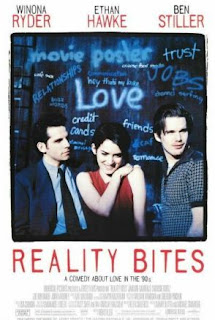
So, having been raised to seek both change and middle class comforts, we can sympathize with those angst-ridden, adulthood-delaying movie characters like Lainy in Reality Bites, who had thought she "was really gonna be something by the age of 23." Getting to where we've been told we should be going can hardly follow the smooth path of college, job, marriage, house, kids that many Americans could in the post-war period.
Maybe that's not such a bad thing, either. Maybe we can find, out of the angst of coming of age in this changed world, a meaning for adulthood that is more fulfilling and productive than simply "fumbling." Oh yeah, and a way to pay for those dentist visits.
In movies and in life, Gen X and Y are listless, rootless, searching for meaning and failing at being adults. Why, if only we knew that what adulthood is really about is (as the author tells us) "fumbling through each day the best one could and remembering to schedule dentist appointments"!
If only that banal vision of adulthood was even available to our generation. Many of us would love to schedule dentist appointments if we had dental insurance. And fumbling the best you can, for our parents, was done from the security of a job and a house. The "quarterlife crisis" the author mocks is not some sort of media creation, but a result of the fact that to be a middle class young adult in America takes a hell of a lot more work, time, education and money than it used to.
 On top of that, society fostered in Gen Y the idea that our generation could Change Things. When you have second graders sent on neighborhood clean-ups and learning about how to save the rain forest, can you blame them for growing up to yearn for something more than a desk job? Sadly, particularly during a recession, our economy just doesn't have that many entry to mid-level jobs available for young people who want to make a difference.
So, having been raised to seek both change and middle class comforts, we can sympathize with those angst-ridden, adulthood-delaying movie characters like Lainy in Reality Bites, who had thought she "was really gonna be something by the age of 23." Getting to where we've been told we should be going can hardly follow the smooth path of college, job, marriage, house, kids that many Americans could in the post-war period.
Maybe that's not such a bad thing, either. Maybe we can find, out of the angst of coming of age in this changed world, a meaning for adulthood that is more fulfilling and productive than simply "fumbling." Oh yeah, and a way to pay for those dentist visits.
Tuesday, June 2, 2009
The PhD rite of passage
In the strange world of academia, there is a period of time when the PhD student sequesters him or herself for several months with the ritual objects referred to as academic literature. She may reduce her social activities, change her eating, drinking, and sleeping patterns, and show signs of acute stress. This period of intensive studying and social isolation is the first step in the Comprehensive Exams rite of passage, a step commonly referred to as separation or segregation.
During the second step of the rite, the liminal phase, the PhD student enters a room with her advisers for a couple of hours for her exams. During this stage, as anthropologist Victor Turner characterizes it, "liminal entities are neither here nor there; they are betwixt and between the positions assigned and arrayed by law, custom, convention, and ceremony." Thus the student is neither in coursework nor in the dissertation phase while in the room; her fate is still to be decided. The "decision" is preordained; the student who enters the ritual will almost always be passed. The tension is created by the ritual, rather than the reality.
The liminal phase climaxes with the end of examination, when the advisers ask the student to leave the room and await her fate. After perhaps 3-5 minutes, the student is asked to reenter the room and congratulated for her success. The student is now ready to be re-integrated into the graduate student community as an ABD--a term mysterious to those outside of the academic culture, but highly significant to those within it.
The student begins re-integration, the final stage of the ritual, by consuming alcohol and snacks with other students down the hall from the examination room. The process continues with more alcohol and likely inebriation in the evening. From this point on, the ABD student will no longer take courses and has attained the status necessary to teach at the collegiate level.
I write this having completed the ritual yesterday, and I can only excuse the arch anthropological tone by having read far too many books in the past four months.
During the second step of the rite, the liminal phase, the PhD student enters a room with her advisers for a couple of hours for her exams. During this stage, as anthropologist Victor Turner characterizes it, "liminal entities are neither here nor there; they are betwixt and between the positions assigned and arrayed by law, custom, convention, and ceremony." Thus the student is neither in coursework nor in the dissertation phase while in the room; her fate is still to be decided. The "decision" is preordained; the student who enters the ritual will almost always be passed. The tension is created by the ritual, rather than the reality.
The liminal phase climaxes with the end of examination, when the advisers ask the student to leave the room and await her fate. After perhaps 3-5 minutes, the student is asked to reenter the room and congratulated for her success. The student is now ready to be re-integrated into the graduate student community as an ABD--a term mysterious to those outside of the academic culture, but highly significant to those within it.
The student begins re-integration, the final stage of the ritual, by consuming alcohol and snacks with other students down the hall from the examination room. The process continues with more alcohol and likely inebriation in the evening. From this point on, the ABD student will no longer take courses and has attained the status necessary to teach at the collegiate level.
I write this having completed the ritual yesterday, and I can only excuse the arch anthropological tone by having read far too many books in the past four months.
Saturday, April 18, 2009
Living history
 Today I heard gun shots, smelled horse dung, felt the cool dank interior of a stone house, watched lace being sewn, and met Pennsylvanians living on the frontier. It was all in about an hour at the colonial plantation at Ridley Creek, a short drive from Philly. Today was their yearly French and Indian War reenactment, where customed French, British and Indian soldiers skirmish outside a bystander's house. While just past the trees to one side you could see the road, from every other angle you could have been back in the 1760s.
While the reenactors at living history sites like this may not have history degrees, they know the nitty gritty details of daily life in the past far better than I do. These people are truly committed: we even watched the reenactors eating soup, cooked in a pot over a fire in the old house's hearth, in wooden bowls along with chunks of homemade bread. Walking through the house, the smell of damp smoke seemed to seep out of the stone walls. Outside, farm animals wandered freely and there was clanging coming from the blacksmith's barn.
The highlight, of course, was the small battle. I don't know military history very well, but I know that the chaos and confusion, the many shots fired to actually hit somebody, and the women running wailing into the scene were authentic. So what if the French soldiers shouted to each other in English and a British soldier was felled by a fake blow from the wooden end of a rifle? You were there for a few minutes.
Subscribe to:
Posts (Atom)